Waste reduction and management
VCU is committed to establishing waste reduction and diversion targets, focusing on single-use plastics and other disposables in athletics, dining, housing and laboratories. Currently, VCU diverts 25 percent of our waste from the landfill through various reducing, reusing and recycling methods.
Composting program
As a part of the One VCU Sustainability Plan implementation, VCU is iIncrease diversion of food waste through composting and food recovery.
In October 2024, VCU established its compositing program in five dining facilities on the Monroe Park and MCV campuses, including: Shafer Court Dining Center, Laurel & Grace Place, University Student Commons, Children's Hospital of Richmond and the Adult Outpatient Pavilion. As of April 2026, more than 124,700 pounds of food waste have been diverted from landfill. Since adding The Student Commons in August of 2025, the average monthly compost diversion increased by 36.97%.
Additionally, as of spring 2026, John Jones, Ph.D., School of Life Sciences and Sustainability, is spearheading an effort to increase the recovery and distribution of unserved food from Shafer Dining Hall. The pilot program has distributed over 1,000 pounds of food to the VCU community and the program’s community partner, RVA Community Fridges.
ReusePass
In April 2025, VCU Dining Services kicked off the ReusePass program at Shafer which offers reusable plastic clamshell to-go containers with an RFID tag to help track its lifespan.
GovDeals
GovDeals is a program, managed by Commonwealth of Virginia Department of General Services but overseen at VCU by VCU Facilities Management, that helps government agencies manage the sale of their surplus inventory (technology, laboratory equipment, furniture and more) and helps keep usable items out of landfills.
Green Game
In February 2025, VCU Sustainability and VCU Athletics teamed up to host the first-ever green game at the Siegel Center. VCU staff, faculty and students guided fans to dispose of recyclable and compostable materials in labeled bins throughout the Siegel Center. At the end of the night, the waste was weighed and resulted in a diversion rate of 76.6% compared to the average diversion rate of 8.1% at the Siegel Center in 2024.
Recycling
VCU utilizes a single stream recycling program (i.e., all recyclable material can be placed in the same recycling bin). Recycling bins are located throughout campus, including residential halls, and are marked with signage indicating the types of materials that can be recycled.
In 2025, VCU also added trash and recycling bins to some of the busiest campus and health system thoroughfares, which contributed to the diversion of 1.6 tons of recycling from the landfill, including specialty streams like metal, lighting, electronics and batteries. The Monroe Park Campus diversion rate increased 33.14%, up from 30.34% in 2024. VCU Health's diversion rate was 9.97%, a change from 10.37% in 2024.
- Paper (e.g., newspaper, copy paper, magazines and posters)
- Plastics #1-7 (e.g., cups, jugs, bottles and food packaging labeled with the recycling icon and #1-7)
- Plastic bags and packaging cannot be recycled in these bins. Plastic bags with the recycling icon can be recycled at many grocery and large retail stores.
- Metal (e.g., soda/soup cans and aluminum foil)
- Cardboard (e.g., unsoiled pizza boxes, cereal boxes, boxes, and paper towel and toilet paper rolls)
Recyclable materials that contained food should be rinsed before recycling to avoid contaminating the recyclable materials. If food contamination cannot be removed from an item (e.g., pizza box with grease), it should be placed in the waste bin.
Download and post the Recycling and Waste SignageRecycling and Waste Signage [PDF] in common areas of your workspace.
Reducing medical waste
The health system has reduced its medical waste volume and hazardous medication waste volumes, the latter of which earned VCU and the VCU Health the Campus Safety Health and Environmental Management Association’s Innovation Award for Research Enhancement for a Large School.
Additionally, the health system reprocesses more than 10,000 medical devices, such as pulse oximeters and ECG leads and cables, each month and recycles more than one million pounds of cardboard and paper annually.
Other recyclable items
- Employees with recyclable batteries, light bulbs or small, non-working electronics can contact their building manager to recycle these items. A list of building managers and contact information can be found on the VCU Facilities Management building managers web page.
- Used printer cartridges can be recycled by placing them in the original box so the vendor can pick them up when dropping off new orders.
- VCU General Services' reuse program invites VCU schools and departments to donate and acquire gently-used items (e.g., furniture, computers and laboratory equipment). For more information, visit the General Services page.
Recycling resources
- Donate reusable items in good condition to the VCU Free Store for other VCU students and employees to take for free. Visit the Free Store page for more information.
- Donate used electronics that are no longer needed. Resident advisors and residence hall directors can provide information about e-cycling on campus.
- Donate unwanted clothing, home decor and other items to local donation stores.
Waste management
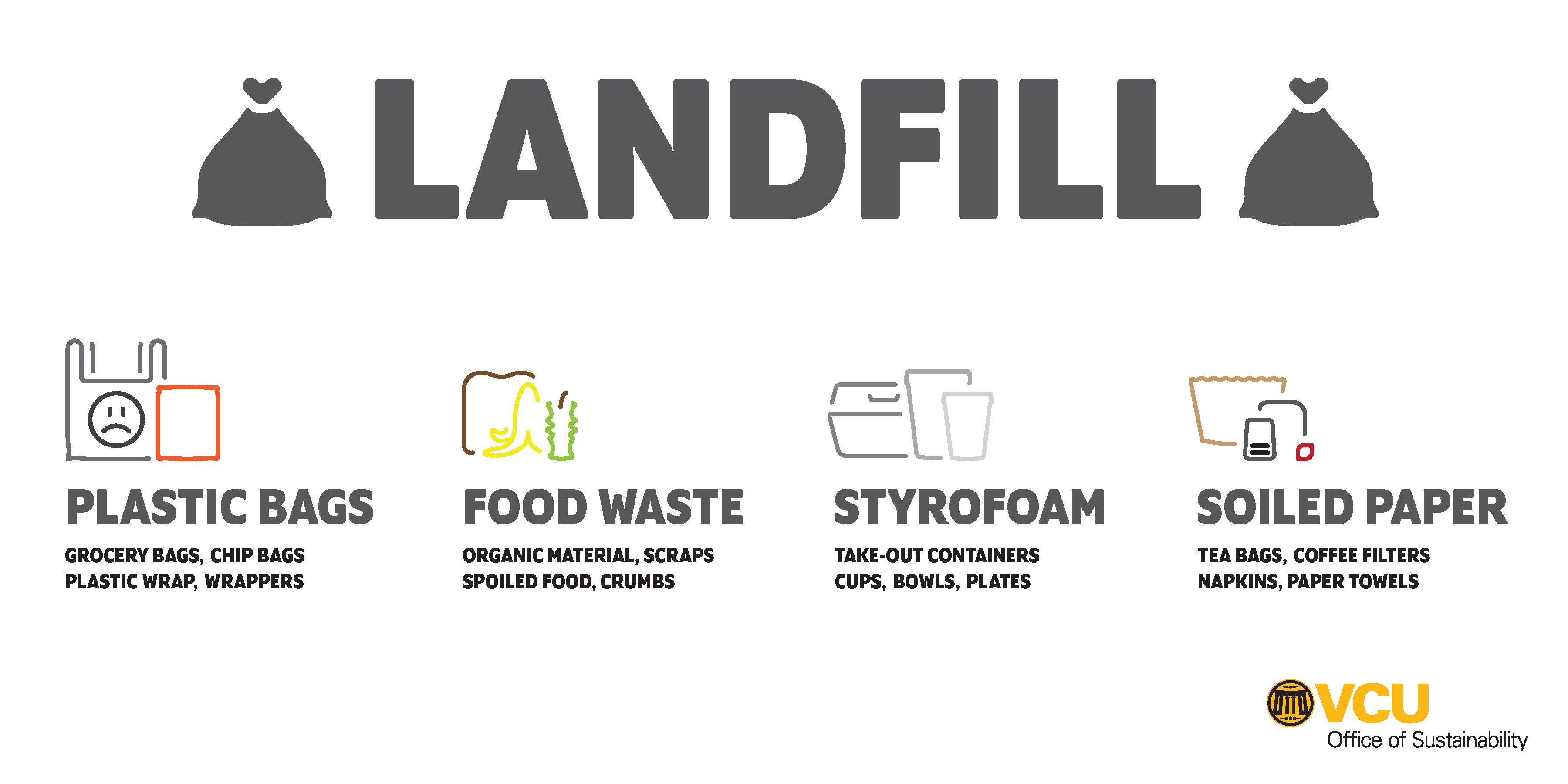
Non-recyclable items should be placed in waste bins located throughout campus. Many of these bins are marked with the signage displayed below. Custodial staff empties waste bins in common areas (e.g., kitchens, break rooms, hallways, restrooms, lobbies and copy rooms) each day. Trash receptacles in individual offices will not be emptied.